The Buyers Are Machines
What a payment layer has to become when the customer is a program with a budget
For thirty years, the web made one quiet assumption about every purchase: at the end of it, there is a person. A person to read the price. A person to decide. A person to type a card number, click confirm, and remember a password next month. Every payment tool we have — checkout pages, subscriptions, invoices, saved cards — is shaped around that person's attention and that person's patience.
That assumption is breaking. Not because people stopped buying things, but because something else started.
A new kind of customer
Software is beginning to purchase on its own behalf. An agent given a task reaches for tools the way a person reaches for a phone: it calls an API for market data, a model for a summary, a service for a translation, another agent for a subtask. Each of those calls has a cost. And increasingly, the thing making the call is expected to pay for it directly, in the moment, without a human stepping in to approve each one.
This customer is nothing like the one our payment rails were built for.
It has no eyes for a checkout page. It will not read a pricing table or compare plans; it wants a number it can act on in a single step. It has no patience for a form. A signup flow with an email confirmation is not a minor friction to it — it is a wall, because there is no inbox and no thumbs. It does not want a relationship. It may call your endpoint once, in the middle of a task it will never repeat, and never return. And it does not hold a card. What it holds is a balance and a budget: spend up to this much, on these things, and stop.
Ask what payment method fits a customer like that, and almost everything we have falls away.
Why the old shapes do not fit
Consider the subscription, the default business model of the modern web. A subscription is a bet that a customer will come back often enough to justify a recurring charge. It is a fine bet when the customer is a person with a habit. It is a terrible bet when the customer is an agent that made exactly one call to your service, because it happened to be the best tool for one step of one task. Charging that agent a monthly fee is charging for a relationship that does not exist. The agent will not subscribe; it will simply route around you to something it can pay per use.
Consider the card. A card payment carries fixed overhead — a fee floor and a percentage — that made sense when the smallest sensible transaction was a few dollars. An agent's call might be worth a fifth of a cent. You cannot put a fifth-of-a-cent charge on a card; the machinery costs more than the payment. The economics that make cards work for humans are exactly the economics that make them useless for machines.
Consider the API key. The industry's workaround has been to bill machines the way we bill companies: issue a key, meter usage, invoice at the end of the month. It works, barely, but it inverts the model. Now every buyer needs an account with every seller before the first call. A key is a long-lived secret that leaks. The relationship is heavy, human-mediated, and slow to form — everything an autonomous, transient buyer is not. It is a human-shaped credential wrapped around a machine, and the seams show.
The problem underneath all three is the same. We keep trying to make the machine behave like the person we designed for. The better move is to design for the machine.
What the machine actually needs
Strip the requirements down and they are almost embarrassingly simple, because a machine has no ego and no impatience beyond latency. It needs to ask for something and be told a price in a form it can act on immediately. It needs to pay that price in one motion, without an account, using a balance it already controls. It needs to receive the thing it paid for, with proof that the payment settled. And it needs to do all of that fast enough and cheap enough that the payment is not the expensive part.
That is not a wish list. It is very nearly a description of 402 Payment Required, the HTTP status code that was reserved for exactly this and left unused for three decades. The server answers a request with a price. The caller signs a payment and asks again. It gets its response. No account, no card, no monthly bill, no key to leak. Pay for exactly what you use, one call at a time.
The reason it went unused so long is that the money to make it work did not exist. A per-call payment only makes sense if a payment can be a fifth of a cent and settle in under a second. On a fast chain with stable value, it can. That is the piece that was missing, and it is the piece that arrived.
The concrete case: paid tools
The clearest place to watch this happen is the tool interface agents already use. When an agent calls a tool, the call goes out over HTTP like any other request. If that tool is paid, the server answers with 402 and a price instead of a result. A payment-aware client sees the 402, signs a payment out of its budget, and retries — and the tool call completes, now settled. From the agent's side, nothing exotic happened: it called a tool, and the tool worked. The payment was a detail handled between the request and the response, the same way a redirect or a retry is handled today.
That is the shape of the thing. Payment stops being a destination the customer travels to — a checkout page, a billing portal — and becomes a step in the middle of a request it was already making. The coin drops on the way through.
Where Otomat sits
Otomat is a rail for that customer. It speaks x402 on Solana, so the payment is a signed transaction that settles in the open, in under a second, for a fraction of a cent. The facilitator pays the network fee, so an agent holding only spendable balance and no gas can still transact. And the agent wallet kit gives the machine's operator the one thing a machine cannot be trusted to have on its own — judgment — in the form of hard limits: a budget it cannot exceed, a whitelist it cannot stray from, a time-window it cannot outrun.
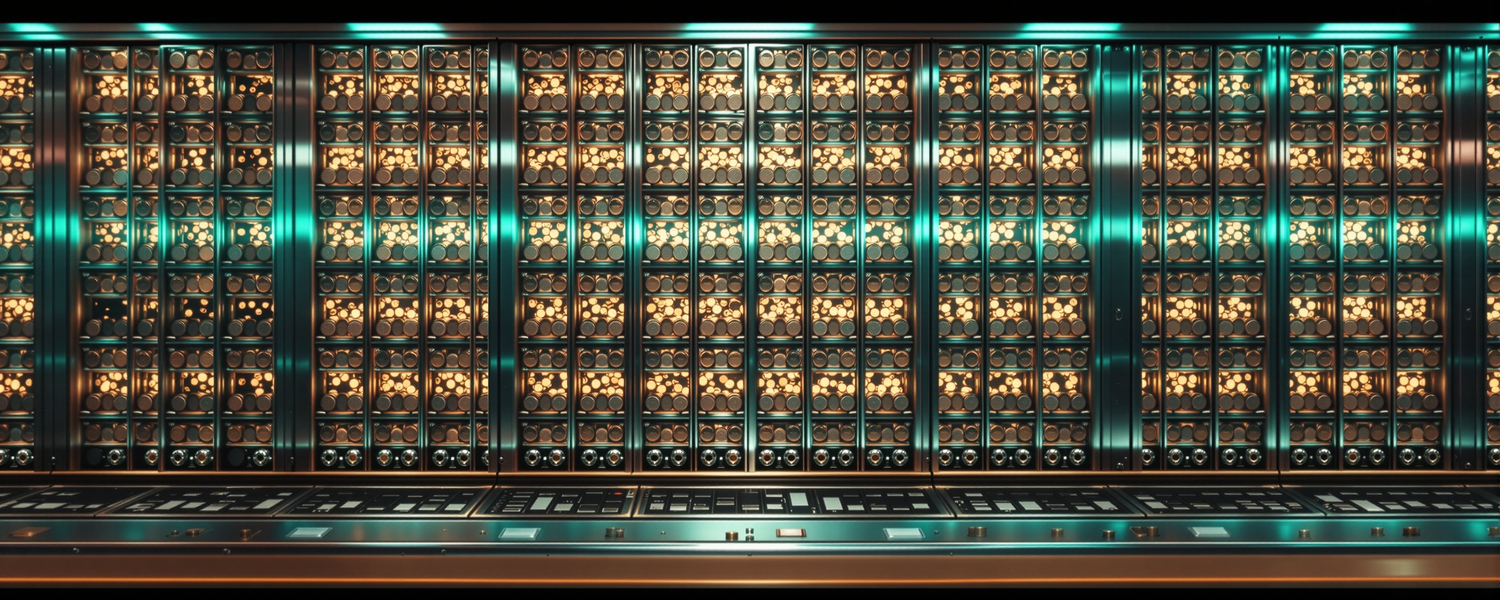
The Automat is, once more, the right picture. Horn and Hardart's wall of glass doors worked because it asked nothing of the customer but a coin and a turn of the knob. No waiter, no tab, no name. Self-service for people, seventy years early. What Otomat builds is the same wall, for a customer that was never going to sit down and order: drop the coin, the door opens, take the response, move on.
The buyers changed. The rail should change to meet them.