The Wall With No Cashier
What a 1950s automat understood about self-service, and what a rail for machine buyers inherits from it
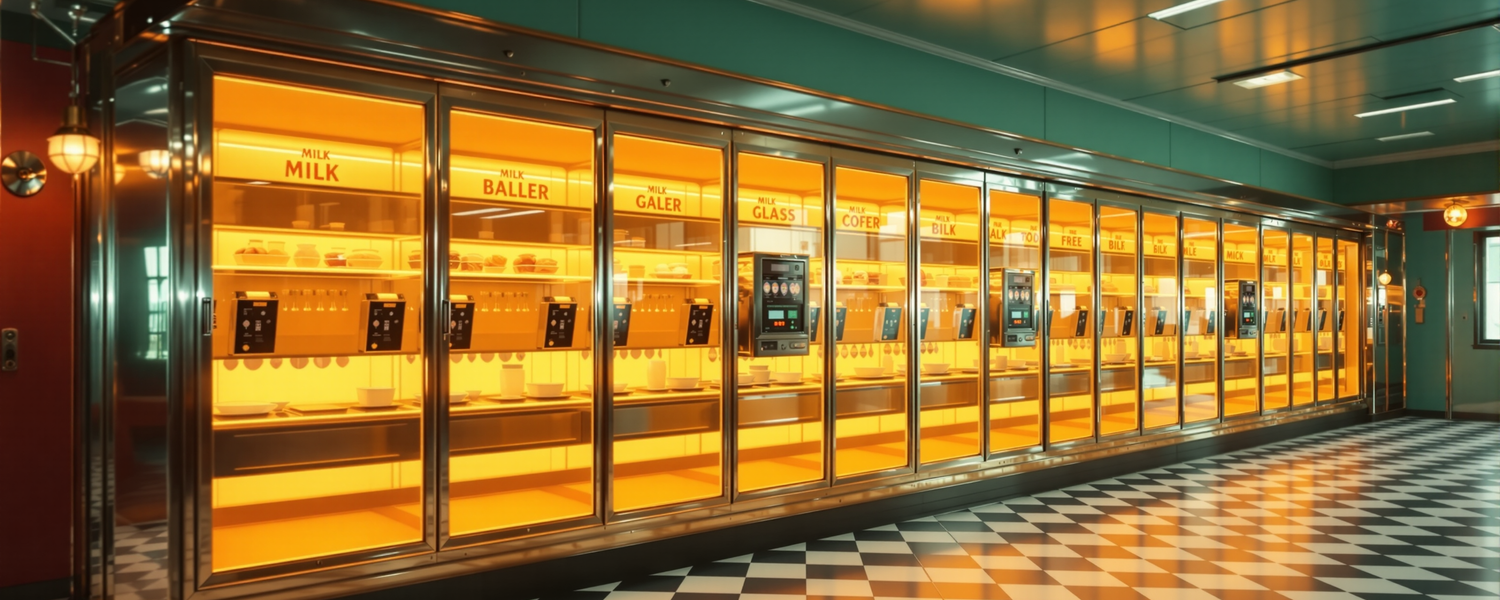
On a busy street corner in the first half of the twentieth century, you could walk into a large bright room, drop a few coins into a slot, turn a chrome knob, and open a small glass door to take out a slice of pie. No waiter took your order. No cashier rang you up at the end. The wall did the whole transaction. It was called the Automat, and for a few decades it was one of the most modern things a person could experience.
It is also, seventy years later, the cleanest possible picture of how a machine should pay another machine. This is a short essay about why that old wall keeps being the right image, and what a payment rail for software buyers actually inherits from a diner that sold pie for a nickel.
The wall itself
Horn and Hardart opened their automats in Philadelphia and New York, and at their peak they served hundreds of thousands of people a day. The design was startlingly simple. A long wall was divided into a grid of small compartments, each behind its own little window of glass. Behind each window sat one dish: a sandwich, a wedge of pie, a bowl of beans. You looked through the glass, chose what you wanted, fed the exact coins into the slot beside it, and turned the knob. The door unlocked. You lifted it, took your dish, and the door swung shut. Out of sight, kitchen staff refilled the compartment from behind for the next customer.
There was no menu to flag down a waiter for, no bill, no tip, no negotiation. The price was posted on the compartment. The coin was the whole conversation. You paid for exactly the one thing you wanted, at the moment you wanted it, and you got exactly that thing in return. Money in, door open.
What made it feel modern was not the food. It was the removal of the human transaction. The Automat took the most ordinary exchange — pay for a meal — and stripped out the cashier, the waiter, the account, the wait. It was self-service before the phrase existed, and it worked because the interface was so simple that a customer needed to understand nothing except the coin and the door.
The thing it got right
Strip the Automat down to its idea and it is a claim about how transactions should work when you remove the people from the middle of them. The claim has three parts, and all three turn out to be exactly what a machine buyer needs.
The first is that the price should be on the thing. In an automat, you did not ask what something cost; the cost was posted on the compartment, right next to it, before you committed a single coin. There was no separate step of finding out the price. The demand and the good were in the same place. That is precisely what a server answering a request with 402 and a price does: the cost arrives attached to the resource, in one step, before anything is paid.
The second is that payment should be a single motion. Drop the coin, turn the knob. There was no account to open first, no tab to reconcile after, no signature on a slip. The act of paying and the act of receiving were one continuous gesture. A machine buyer wants exactly this: sign the payment, retry the request, receive the response, all in the flow of the call it was already making. No detour to a checkout.
The third is that the mechanism should be simple enough to trust by looking. You trusted the automat wall because you could see how it worked. Coin in, lock releases, door opens, dish out. Nothing was hidden that you needed to worry about. The trust came from the transparency of the mechanism, not from a brand or a promise. A well-built payment rail earns trust the same way: the exchange is legible, the settlement is on a public ledger, and the one trusted part is small and named rather than buried.
The buyers changed; the wall did not have to
For most of the last century, the customer at the wall was a person with a coin. Today, increasingly, the customer reaching for a slot is a piece of software. An agent working through a task needs data, a computation, a service — and it needs to pay for each one, per call, without a person clicking approve. It is a customer with a budget and no patience for forms, no eyes for a checkout page, no card to enter.
Here is the quiet joke of it. Almost everything we built for human customers over the last few decades — the accounts, the subscriptions, the saved cards, the billing portals — is exactly the machinery the Automat had already removed. We spent a century adding the cashier back. The machine buyer does not want the cashier. It wants the wall.
So the wall does not have to change much to serve it. The compartment is now a web address. The dish behind the glass is a response — some data, an answer, a result. The coin is a tiny payment in stable value that settles on a fast public chain. The knob is a signature. And the door swinging open is a 200 OK with a receipt. Every part of the old machine maps onto a part of the new one, because the old machine was already the right shape. It was just seventy years early, and waiting for a customer who would never have sat down to be served anyway.
What Otomat inherits
Otomat is that wall, rebuilt for machine buyers on Solana. The grid of compartments is a set of priced endpoints. The coin mechanism is the x402 exchange: a request answered with a price, a signed payment, a settlement, a response. The rail behind the wall — the part the customer never sees — is the facilitator that carries the coin to the chain and the settlement program that makes the money actually move, bonded so the one trusted piece stays honest.
The point of leaning on a seventy-year-old diner is not nostalgia. It is that the Automat already solved the human version of this problem and proved the shape works: a customer, a coin, a compartment, a door, and nothing in between. What is new is not the shape. What is new is that the money can finally be small enough and fast enough for the buyer to be a machine, and that the buyer, at last, is one.
The wall never needed a cashier. It turns out it never needed a person on the other side of the glass either. Insert coin. Receive response.